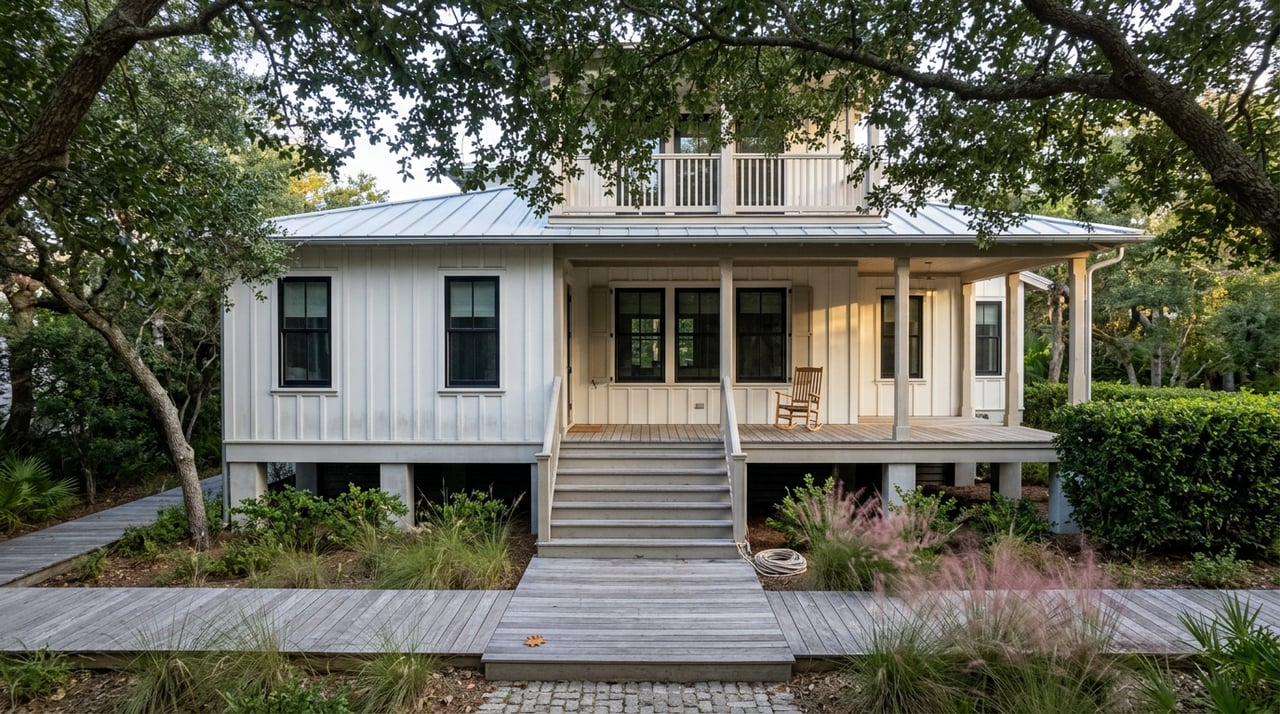
As SoWal reported, for as long as anyone can remember, getting to the sand in Seagrove has meant parking somewhere else first. A bike rack at the house, a walk down a shaded lane, a beach cruiser leaned against a fence post at one of the neighborhood's dozen or so access points. None of them had a lot. Most locals will tell you that's part of what kept this stretch quiet while the rest of 30A built out.
So why did Walton County just finish an $8.9 million project that gives one access point 23 parking spaces, a full restroom building, and its own staffed lifeguard tower?
The Seagrove Regional Beach Access is now open at 3910 E. County Hwy 30A, directly across the road from Café Thirty-A near the Highway 395 junction. It's the county's tenth regional beach access, and it is the first time a stretch of Seagrove built around walk-only and bike-only entry has gotten a real front door for cars. That choice of location, not just the amenity itself, tells you something about how the county reads traffic in this neighborhood.
The Corner That Finally Got Fixed
If you've lived here through a few summers, you already know which corner backs up first. The block around Café Thirty-A and Highway 395 has functioned for years as Seagrove's de facto town center, restaurant, market, and short walk to the water, without a single dedicated public lot to absorb the cars that gather there for dinner. Everywhere else in the neighborhood, the county could have added parking at a quieter residential access and called it done. Instead, it built its newest and largest access point at the one corner already carrying the heaviest car traffic in Seagrove.
That's a deliberate bet on where cars belong here. Rather than spreading capacity thin across several sleepy walk-only accesses, the county concentrated it at the address already absorbing the most vehicle activity, which means the rest of Seagrove's access points keep their car-free character while this one intersection takes on the job of being the neighborhood's on-ramp.
What the Money Actually Bought
The full breakdown, drawn from the county's own project figures, looks like this:
| Line item | Cost |
|---|---|
| Land acquisition | $5,000,000 |
| Engineering and permitting | just over $200,000 |
| Construction | roughly $3.7 million (the remainder) |
| Total | $8.9 million |
In its report, SoWal quotes Beach Operations Director Josh Ervin noting the project came in under its construction budget, a detail he seemed genuinely pleased about:
"We actually finished under budget this year with this project, so you know, we always like to celebrate those."
Here's the part that matters most for anyone who already owns or rents in Seagrove: none of that $8.9 million came from property taxes. The entire project was funded through the county's tourism development tax, a 5 percent charge collected on stays of six months or less at hotels, condos, single-family rentals, and campgrounds. In plain terms, the people who stayed in short-term rentals paid for the lot that now serves everyone, including the full-time residents who never collect a nightly rate.
What's Physically There Now
The finished access includes:
- 23 parking spaces, with dedicated spots for standard vehicles, ADA accessibility, and bicycles
- A 1,011-square-foot restroom and shower building
- An ADA-accessible dune walkover with rinse showers at the base
- A stormwater exfiltration system built to capture runoff from the surrounding neighborhoods before it reaches the coast
- A direct tie-in to the 30A multi-use path, turning the site into a rest stop for cyclists as well as an entry point for swimmers
That last item is easy to overlook but changes something real. Anyone who bikes the multi-use path between Seaside and points east now has a bathroom, water access, and a place to lock up mid-ride that didn't exist before this year.
A Lifeguard Where There Wasn't One
The access also comes with Tower 21, a new lifeguard station staffed daily from 10 a.m. to 6 p.m. through October 31. It brings the South Walton Fire District's total to 19 staffed towers spread across 26 miles of coastline. Before this year, that particular stretch of sand had no on-site lifeguard at all. Anyone swimming there did so unsupervised, the same as most of Seagrove's other walk-only accesses still are today.
Worth flagging for anyone who swims into the shoulder season: that coverage ends October 31. Come November, this stretch reverts to the same unsupervised status as the rest of the neighborhood's beach frontage.
Nine Years for One Address
The county bought the land back in 2017. It took nearly nine years, and about five of those years just for design and permitting, to get from that purchase to a finished access point. For all that time and money, the project added only 100 feet of additional public beach frontage. That's a modest number if you're counting sand, but the point was never square footage. Seagrove is one of the original communities on this stretch of coast, older than the planned towns that came later, and it grew up without the kind of formal infrastructure those newer communities built in from day one. This project is less about adding beach and more about giving one corner of an organically grown neighborhood its first proper entrance.
What This Actually Changes
The honest answer is that nobody knows yet how this settles in over a full year. It's reasonable to expect that visitors who used to circle the Highway 395 corner hunting for a legal place to leave a car now have somewhere to go instead of drifting onto residential side streets. It's just as reasonable to expect that a corner already busy at dinnertime gets busier once people realize they can park there for the beach, too. Both things can be true. The design intent from the county is clear either way: give the corner that already draws cars a proper place to put them, rather than ask a quiet lane elsewhere in the neighborhood to take on that role.
If you walk, bike, or drive through Seagrove regularly, this fall is the season to watch it happen. The lot is open, the lifeguard tower is staffed through the end of October, and the corner across from Café Thirty-A looks different than it has for as long as most residents can recall.
If shifts like this one have you thinking about what's changing in the neighborhood you already call home, or what it might mean for a property you own here, the team at Mark Stroop LLC follows these changes up and down 30A as part of daily work, not just annual reports. Reach out anytime, or start with a free home valuation to see where your property stands today.
This article is general information, not legal, tax or financial advice. Consult a qualified professional about your situation.